

News & Insights
Photo courtesy of: Greg Land
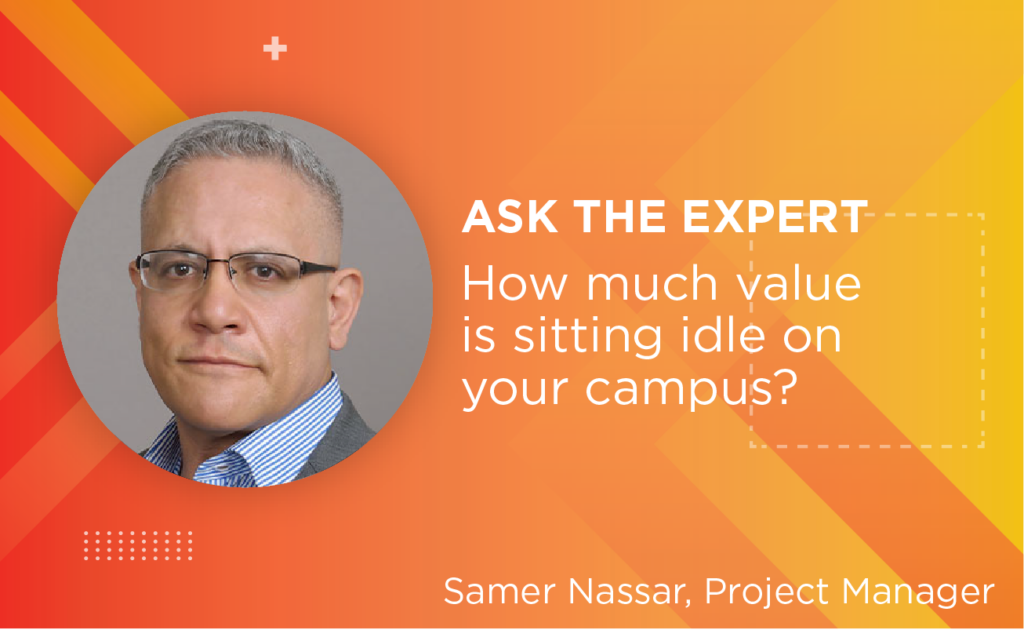
Samer Nassar discusses how community colleges can get more from the spaces they already have
What could your college accomplish if its classrooms, meeting rooms, athletic facilities, and training centers were used more often and by more people?
As financial pressure grows, that question is becoming harder to ignore. B&D Project Manager Samer Nassar believes colleges can uncover new opportunities by taking a fresh look at how their existing facilities are scheduled, shared, and programmed. And it doesn’t always take a major renovation. Sometimes, it starts with a simple question: Who else could use this space?
B&D: What will it take for community colleges to get more from the facilities they already have?
Samer Nassar: The name of the game is optimization. Colleges have to stop thinking, “This building belongs to my department,” and start asking, “How can we reduce the amount of time this space sits empty?” So when departments share a facility, there’s a lot more potential. That doesn’t necessarily require a major physical change. It might mean more intentional scheduling, more flexible uses, or better coordination across the college and with outside partners.
B&D: What’s keeping more colleges from doing that now?
SN: A lot of it comes down to how people think about the space. If a building or room has always been used for one purpose, people tend to keep using it that way. They don’t always stop to ask what else might be possible. This means college leaders can start by looking beyond departmental ownership. Instead of asking, “What do we use this space for now?” ask, “Who else could use it, and when?” Just that small shift can open up a much bigger conversation.
B&D: How can this help colleges build stronger connections with their communities?
SN: I encourage colleges to think of their facilities as a bridge to the community. They have classrooms, meeting spaces, athletic facilities, and training centers that could also support nonprofit organizations, local employers, public agencies, and community groups. When colleges open their doors in that way, the campus can then become a shared resource for the larger community.
B&D: So should community engagement be part of the facility planning conversation from the beginning?
SN: Absolutely. Facility planning and community engagement shouldn’t be two separate conversations. Colleges can look at when their spaces are available, what the surrounding community needs, and where there might be a match. Of course, they’ll still need to think through scheduling, operations, budgets, and maintenance. Those are real considerations. But they shouldn’t keep leaders from exploring what’s possible.
B&D: What about colleges that are planning a new building or renovation? Where should they begin?
SN: The first question should always be, “What problem are we trying to solve?” Once you’ve answered that, you can start looking at the larger picture. For example, if a building is doing a good job providing support for one or two school programs, there’s a good chance it can support more programs or community needs too. That’s when you start asking questions like: Can more than one department use this space? Could it serve different purposes at different times? Could it support needs that emerge in the future? Could it help the college build stronger community partnerships?
B&D: What’s the biggest opportunity for colleges that are willing to rethink how they use their facilities?
SN: It’s the opportunity to create more value from what they already have.
Thoughtful programming, flexible use, and better coordination can help colleges serve more people without assuming that every challenge calls for another building, because many times, the goal isn’t just to keep a facility busy. It’s to make sure the space is helping the college move its priorities forward and strengthen its connection to the community.
—
Ask the Expert is written and produced by Allison Bruns. Thank you to Samer Nasser for participating. Have a question you’d like one of B&D’s experts to answer in a future issue? Click here to submit a topic.


