

News & Insights
Photo courtesy of: Greg Land
The next evolution of energy resilience for public schools and municipalities
Put a school superintendent, a facilities director, and a town’s emergency manager around the same table and ask whether the high school has backup power. The answers will not match. The superintendent is thinking about keeping school open. The facilities director knows exactly which circuits the generator serves. The emergency manager is picturing cots in the gym. All three are right, but they are defining different expectations for the same facility.
That difference is the place to start. Before a district or municipality evaluates a battery or a microgrid, it needs agreement on what the facility is expected to do when the power goes out.
For years, energy efficiency has offered public officials a clean way to evaluate improvements: spend money on equipment, use less energy, and recover the investment through lower bills. There is a lot to like about that, and no district needs to apologize for saving money it can put back into classrooms. But a payback calculation does not tell a superintendent whether the cafeteria can still serve lunch, or a town manager whether residents have anywhere to escape dangerous heat.
Those questions belong in the same capital decisions. Otherwise, a community can spend a decade improving individual buildings and still have nowhere dependable to send people in an emergency.
This is not a hypothetical role. Generation180’s 2026 Brighter Future report finds that roughly one-third of U.S. public K-12 schools are FEMA-designated emergency shelters. The same report contains the first national count of battery storage at schools: just 155 have installed it since 2016, fewer than 0.1 percent. More than 10,800 schools now have solar power. Almost none of them can use it when the grid goes down. Schools are already being asked to play a resilience role in their communities. In many cases, the infrastructure has not caught up with that expectation.
Keeping a facility useful during an outage can mean very different things depending on its role, and those differences are not always reflected in the capital plan. Keeping classes running through a short interruption is one thing. Opening a school as an overnight shelter is another, with different staffing, sanitation, access, and power requirements. A library may be the better cooling center because of its location, accessibility, operating hours, or proximity to the people it needs to serve. A water pumping station may be critical even though nobody gathers there. Those distinctions should shape which facilities get prioritized and what infrastructure they need.
A community is better served by identifying the facilities that matter most during an outage and defining what each needs to support. That means deciding which spaces will operate, who they need to serve, and how long they need to function without utility power, then checking those assumptions with the people who operate and maintain the facilities. A gym may have emergency lighting while the equipment that keeps it cool sits on an entirely different circuit.
Pine Point School in Minnesota offers a working example. In May, the White Earth Nation and its partners celebrated completion of the Pine Point Resilience Hub, a 500-kilowatt solar array paired with a 2.76-megawatt-hour battery at a K-8 school that also serves as a community gathering place. The system is designed to keep the facility operating through an outage, supporting needs such as medical equipment, refrigerated medication, and winter shelter. The project was assembled with no upfront cost to the school through a combination of federal, state, philanthropic, and other funding.
Rooftop solar is the clearest example of why the details matter. A conventional grid-connected array shuts down when the grid fails, leaving panels in full sun above a dark facility. As the Department of Energy explains, supplying power during an outage requires a system designed for that purpose, including appropriate inverters, storage, controls, and the ability to disconnect safely from the grid. Solar is an important part of many resilience strategies, but the panels themselves do not make a facility resilient.
I have also run into too many situations with clients where systems installed a decade ago are no longer operating as intended, sometimes because no one was actively monitoring their performance. That matters even more when the system is expected to serve a resilience function. Seeing solar panels on the roof tells you very little about what will actually be available when the grid goes down.
Battery sizing deserves the same scrutiny. The questions are which equipment it can run, for how long, and under the conditions actually being planned for. An afternoon interruption and four cloudy winter days are different problems. A system that saves money by discharging at expensive times also needs an operating plan for how much energy to hold in reserve. The Department of Energy maintains resilience planning resources, including NREL’s free REopt model, which estimates how many hours a given system can sustain a critical load during an outage. That is more useful than comparing battery sizes on their own.
Efficiency belongs in the same conversation. Insulation, better windows, a tighter envelope, and better control of heating and cooling all reduce the load . They can also buy time during an outage. Building resilience researchers use the term passive survivability to describe a facility’s ability to maintain safe, habitable conditions when normal systems are unavailable. A recent report prepared for the International Energy Agency’s Building Energy Codes Working Group highlights its importance in facilities where extended outages can have serious consequences, including schools and hospitals. When a roof replacement or renovation is already on the capital plan, examining those opportunities first can make the same battery or backup system go further.
Electric school buses add another opportunity. With compatible vehicles and bidirectional charging equipment, which allows electricity to flow both into the bus battery and back out to a building or the grid, a parked bus can become part of a facility’s backup power strategy. Porterville Unified School District in California is developing a project that combines a 763-kilowatt solar array, a 408-kilowatt / 1,632-kilowatt-hour battery, a microgrid controller, and 35 fast-charging ports for its electric school bus fleet. The district is also participating in a separate California Energy Commission pilot that will use bidirectional school buses, stationary battery storage, and controls to provide backup power to its districtwide cold-storage facility. That is the more important lesson: the project starts with a critical service that needs to stay operating, then uses the buses and other energy assets to support it.
I explored a similar question in a recent episode of the Campus Energy and Sustainability Podcast with Jason Washington of Prince George’s County Public Schools. His district has more than 1,000 buses, with 21 electric buses already in service and eight more planned at the time of our conversation. As the district considers vehicle-to-building applications, the discussion quickly moves beyond the bus battery itself to where buses are parked, when they need to be available, and which portions of a school actually need backup power.
Roanoke City Public Schools, a district of roughly 14,000 students, spent years installing solar to lower utility bills, with nearly 9.4 megawatts planned or already in place across 29 sites. That work was justified on cost. The resilience came later, and it came as an addition to equipment the district already owned. As Canary Media reported, Roanoke is now adding a solar-and-battery microgrid at each of its two high schools, both designated by the Virginia Department of Emergency Management as public shelters, with gymnasiums originally designed for that purpose. Each site gets one megawatt of solar and four megawatt-hours of storage.
Three things about that project are worth noting.
Roanoke is the first district in Virginia to use that shelter grant for a solar microgrid rather than a diesel installation. The fund runs on an annual cycle, so districts in the Commonwealth should confirm current deadlines with the Virginia Department of Emergency Management.
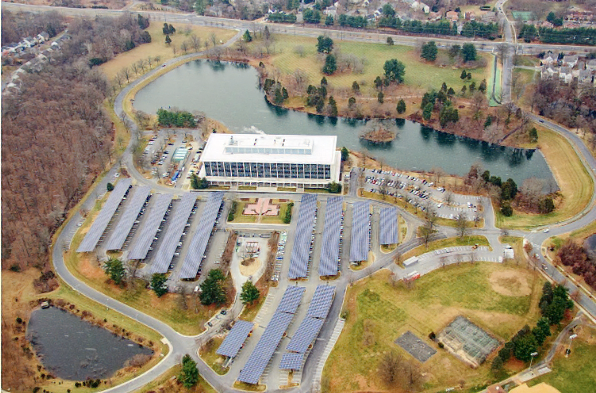
Local governments have parallel options. Montgomery County, Maryland activated microgrids at its Public Safety Headquarters and correctional facility in 2018, allowing both facilities to operate independently from the grid. It later developed a neighborhood resiliency hub at the Bette Carol Thompson Scotland Recreation Center, designed to give nearby residents a place to shelter, refrigerate medication, and charge phones during an extended outage. The County plans to expand that model to additional sites.
Delivery and financing can take different forms, but the business case still needs to show the full long-term cost. That includes ownership or contracted service costs, maintenance, eventual equipment replacement, and the value of energy savings alongside benefits that do not necessarily show up on a utility bill. Keeping a cooling center available during an outage has public value even if the electric savings alone do not pay for it. That tradeoff should be clear to everyone involved in setting capital priorities.
Resilience depends on people as much as equipment. Someone has to know how the controls operate when the usual operator is away. School and municipal staff need an agreed process for opening a shelter, communicating with residents, supporting critical services, and returning the facility to normal use afterward. In smaller communities, those responsibilities may fall to a very small team already stretched during an emergency. Those capabilities take training and practice, and they do not arrive with the equipment warranty.
For most districts and municipalities, this work does not begin with funding for a new energy system. It begins with a boiler due for replacement, a renovation, or a fleet purchase already on the capital plan. Those individual decisions are opportunities to build toward a more resilient system over time. Without that broader plan, even perfectly reasonable investments can end up working against one another.
At the next capital planning meeting, put a map of the community on the table and walk through an outage together. Pick the facility residents would be told to go to. Follow the route there. Ask what will still be operating when they arrive, how long it can operate, and who is responsible for opening and supporting the facility. The answers may point to a different first investment than the one already on the agenda.
B&D is available to support districts and municipalities evaluating energy resilience within their existing capital plans.
Dave Karlsgodt leads Brailsford & Dunlavey’s Infrastructure, Energy & Sustainability practice group and is the creator and host of the Campus Energy and Sustainability Podcast. He can be reached at dkarlsgodt@bdconnect.com. Photo credit: Montgomery County, Md.


